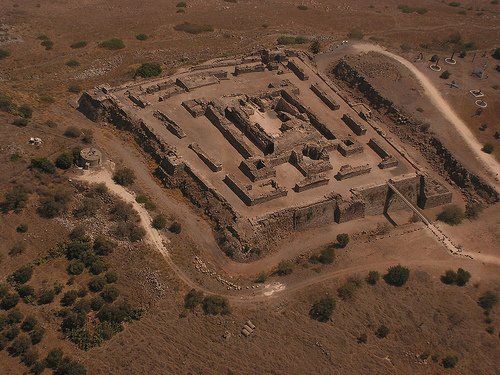
Location: 27 km (17 mi) South of Tiberias
Belvoir Castle, also known as Kochav HaYarden (Hebrew: "Star of the Jordan") and Kawkab al-Hawa (Arabic: "Star of the Wind"), is a remarkably well-preserved Crusader castle located in northern Israel. Situated on a hilltop on the eastern edge of the Issachar Plateau in Lower Galilee, approximately 20 kilometers (12 miles) south of the Sea of Galilee, the castle stands 500 meters (1,600 feet) above the Jordan River Valley. It is part of Belvoir National Park (officially Kochav HaYarden National Park) and is celebrated as one of the best-preserved Crusader fortresses in Israel.
Belvoir Castle’s history is deeply tied to the Crusader period
(1095–1291 CE) and the broader geopolitical struggles of the medieval
Holy Land. Its story reflects the rise and fall of the Crusader Kingdom
of Jerusalem and the region’s complex cultural and military dynamics.
Pre-Crusader Period:
The site was occupied long before the
Crusaders arrived. Archaeological evidence suggests it was home to a
Jewish village called Kochava during the Roman and Byzantine periods
(2nd–6th centuries CE). Excavations have uncovered reused synagogue
elements, such as a lintel with a menorah, indicating a significant
Jewish presence.
The name "Kochava" (meaning "star" in Hebrew) likely
inspired the later Hebrew name Kochav HaYarden.
Crusader
Construction (12th Century):
The castle’s origins as a fortified site
date to around 1140, when it was a modest fortified farmhouse owned by
the Velos family, French nobles from Tiberias. In 1168, the site was
sold to the Knights Hospitaller, a Catholic military order dedicated to
defending the Holy Land, for 1,400 besants.
Under Gilbert of
Assailly, Grand Master of the Knights Hospitaller, construction of the
current fortress began in 1168. The Hospitallers recognized the site’s
strategic importance and transformed it into a major stronghold, making
it one of their most significant castles alongside Krak des Chevaliers
in Syria.
Crusader Period and Conflicts:
Belvoir was designed
to guard the eastern frontier of the Crusader Kingdom of Jerusalem,
controlling the route from Gilead (modern-day Jordan) via a nearby
Jordan River crossing. Its elevated position allowed surveillance of the
Jordan Valley, Galilee, and key roads to Jerusalem.
The castle
withstood a Muslim attack in 1180, demonstrating its defensive strength.
In 1182, the Battle of Belvoir Castle (also known as the Battle of Le
Forbelet) was fought nearby, pitting King Baldwin IV of Jerusalem
against Saladin, the Ayyubid sultan. The battle was inconclusive, but
Saladin’s nephew, Farrukh Shah, raided the Galilee, exploiting the
Crusaders’ focus on Belvoir.
Following Saladin’s decisive victory at
the Battle of Hattin in 1187, Belvoir was besieged. The siege lasted 18
months, with the Hospitallers holding out until January 5, 1189, when
they surrendered and were granted safe passage to Tyre.
Post-Crusader Period:
After its capture, Belvoir was occupied by an
Arab governor until 1219, when the Ayyubid ruler in Damascus ordered it
partially dismantled (slighted) to prevent Crusader reoccupation.
The
castle was ceded back to the Franks in 1241 and remained under their
control until 1263. During the Ottoman period (1517–1917), the site
became an Arab village named Kawkab al-Hawa, built among the ruins.
In 1947–1948, during the civil war phase of the First Arab–Israeli War,
the village’s inhabitants fled in anticipation of advancing Zionist
forces. The Arab buildings were demolished by Israeli authorities
between 1963 and 1968 to facilitate archaeological excavations.
Modern Archaeological Exploration:
Excavations in the 1960s, led by
the Israel Department of Antiquities under Meir Ben-Dov, revealed the
castle’s sophisticated design, overturning earlier assumptions that it
was a simple fortress. Further excavations between 2013 and 2016,
including Franco-Israeli efforts, uncovered additional details, such as
Byzantine synagogue fragments.
The site was restored and opened as a
national park, preserving its historical and architectural legacy.
Significant finds, including the chapel’s sculpted decor, are displayed
at the Israel Museum in Jerusalem.
Belvoir Castle is a pioneering example of the concentric castle plan,
a design that influenced military architecture for centuries. Its robust
construction and strategic layout reflect the Hospitallers’ advanced
understanding of fortification.
Overall Design:
The castle
consists of two concentric square enclosures: an outer fortress (110 x
110 meters) surrounding a smaller inner fortress (50 x 50 meters). This
concentric layout, with multiple layers of defense, was innovative for
the 12th century and anticipated later European designs.
The castle
is built primarily from black basalt, sourced locally, with limestone
used for finer details and the inner ward’s upper levels. Iron joints
reinforced the ashlar stone walls.
Outer Fortress:
The outer
wall, originally 12–16 meters high and 3 meters thick, was surrounded by
a deep moat (14 meters deep, 20 meters wide) on the north, west, and
south sides. The eastern side relied on the natural slope for defense.
Rectangular towers projected from the corners and midpoints of the
walls, with three southwest towers containing staircases to hidden
posterns for surprise sorties. A barbican (an external tower) on the
eastern side controlled the slope below.
The inner face of the outer
wall was lined with an 8-meter-wide barrel vault, providing covered
space for stables, storehouses, smithies, and personnel. This vault also
supported a terrace for defenders to fire from embrasures.
Inner
Fortress:
The inner enclosure, two stories high, featured four corner
towers and an additional tower on the west wall, housing a large
gatehouse. The upper story served as the command headquarters, with
knights’ apartments and a small limestone chapel with cross-vaulted
roofing.
Large cisterns stored rainwater, ensuring the castle could
withstand prolonged sieges. The courtyard between the inner and outer
walls contained additional halls and defensive positions.
Entrances:
The main gate was at the southeastern corner, protected by
the barbican. A secondary gate on the west, accessed via a timber bridge
over the moat, was used in peacetime but could be sealed during sieges.
The design prevented tunneling by enemies, as the moat and solid basalt
foundations made such attacks impractical.
Architectural
Significance:
Belvoir’s design resembles a Roman castrum, with its
rectangular layout, corner towers, and central gatehouse. Historian
H.J.A. Sire notes that its concentric plan “was to influence castle
design for the next several centuries.”
The castle’s symmetry and
robust vaulting provided both defensive strength and practical living
spaces, making it a model for later Crusader and European
fortifications.
Belvoir’s location and design made it a critical stronghold in the
Crusader Kingdom of Jerusalem:
Geographic Advantage:
Perched
500 meters above the Jordan River Valley, Belvoir commanded panoramic
views of the Jordan Valley, Sea of Galilee, Mount Gilboa, and the Golan
Heights. It overlooked a key river crossing and roads connecting Gilead
to Jerusalem, allowing the Hospitallers to monitor and disrupt Muslim
movements.
The castle’s isolation on a bluff, with steep slopes on
the eastern side, enhanced its defensibility, making it a formidable
obstacle to invaders from the east.
Military Role:
Belvoir
enabled the Hospitallers to raid Muslim merchant convoys crossing the
Jordan and to alert nearby Crusader strongholds (e.g., Nazareth, Safed,
Beit Shean) of approaching armies.
Its ability to withstand a
year-and-a-half siege after the Battle of Hattin underscores its
defensive prowess, even when isolated.
Cultural Context:
The
castle’s European-style moat, an unusual feature in the arid Middle
East, reflects the Crusaders’ adaptation of Western military
architecture to the Holy Land.
Reused Jewish synagogue elements
highlight the region’s layered history, connecting the Crusader fortress
to earlier Jewish settlements.
Excavations, particularly in the 1960s and 2013–2016, have provided
significant insights into Belvoir’s construction and history:
1963–1968 Excavations:
Led by Meir Ben-Dov, these excavations
revealed the castle’s concentric design, previously thought to be a
simple single-enclosure fortress. The discovery of the inner and outer
wards, moat, and vaulted spaces reshaped understanding of Crusader
military architecture.
Artifacts, including the chapel’s sculpted
decor, were uncovered, with major pieces now housed at the Israel
Museum.
2013–2016 Excavations:
Franco-Israeli teams further
explored the site, confirming the reuse of Byzantine synagogue elements
(e.g., menorah lintels, friezes, pilasters), suggesting a nearby Jewish
village or synagogue.
These findings underscored Belvoir’s connection
to the region’s pre-Crusader Jewish history.
Restoration:
After the 1960s excavations, the site was cleared of Ottoman-era village
remains and restored as a national park. The restoration preserved the
castle’s foundational structures, allowing visitors to trace its
original layout.
Today, Belvoir Castle is a major historical and tourist attraction
within Belvoir National Park, offering a blend of history, architecture,
and natural beauty.
Belvoir National Park:
The park
encompasses the castle ruins and surrounding landscape, featuring hiking
trails, picnic areas, and observation points like the Dan Shomron and
Eastern Gate viewpoints, which offer stunning vistas of the Jordan
Valley and Sea of Galilee.
A sculpture garden by Israeli artist Yigal
Tumarkin adds a modern artistic element to the site.
Visitor
Experience:
The castle is accessible via a modern walkway over the
moat, leading to the main gate. Visitors can explore the outer and inner
courtyards, towers, cisterns, bathhouse, and chapel remains, with
interpretive signs explaining the layout.
The site is
family-friendly, with open spaces for children to explore and play among
the ruins. It’s particularly appealing in spring, when the surrounding
hills are green and dotted with wildflowers.
The castle’s symmetry
and intact foundations provide a clear sense of its original structure,
making it a favorite for history enthusiasts and those interested in
Crusader architecture.
Cultural and Educational Role:
The park
offers guided tours and occasional historical reenactments, immersing
visitors in the Crusader period. Educational displays highlight the
castle’s history and the region’s flora and fauna.
Belvoir’s role in
the Crusades and its layered Jewish, Christian, and Muslim history make
it a valuable site for understanding the Holy Land’s complex past.
Access and Logistics:
Location: Off Road 90, north of Beit Shean,
with a turn onto Road 717. The access road is narrow and winding but
well-signposted.
Opening Hours: Summer (Sunday–Thursday, Saturday:
8:00 AM–5:00 PM; Friday/holiday eves: 8:00 AM–4:00 PM); Winter
(Sunday–Thursday, Saturday: 8:00 AM–4:00 PM; Friday/holiday eves: 8:00
AM–3:00 PM). The entrance closes one hour earlier.
Facilities:
Parking, toilets, drinking water, barbecue areas, and picnic tables are
available. The site is moderately accessible, with some uneven terrain.
Travel: A 2-hour drive from Tel Aviv or 90 minutes from Netanya,
accessible only by car. Visitors can use Waze, entering “Kokhav HaYarden
National Park.”
Belvoir Castle is more than a military relic; it embodies the
cultural and historical intersections of the Holy Land:
Crusader
Legacy:
As one of the best-preserved Crusader fortresses, Belvoir
offers a tangible link to the 12th-century Kingdom of Jerusalem and the
Knights Hospitaller’s mission. Its concentric design marks a milestone
in military architecture.
Jewish Heritage:
The site’s
pre-Crusader Jewish history, evidenced by synagogue fragments, connects
it to the region’s ancient Jewish communities, enriching its historical
narrative.
Muslim and Ottoman Periods:
The castle’s role under
Ayyubid and Ottoman rule, culminating in the village of Kawkab al-Hawa,
reflects the region’s diverse cultural layers. The 1947–1948
displacement of the village’s inhabitants remains a sensitive aspect of
its modern history.
Tourism and Education:
Belvoir’s status as
a national park and its inclusion in Israel’s tourism circuit make it a
key destination for understanding the Crusades and the Holy Land’s
medieval history. Its scenic beauty enhances its appeal as a cultural
and recreational site.